Shareholder update sent in June 2026, reproduced as sent. Information speaks as of that date; see later updates for current status.
We are pleased to update shareholders on the Company’s exploration activities in Saudi Arabia. Greyridge’s projects have advanced materially over the past six months: our Bahila prospect at Al Amar is ready for target-testing with drilling planned for early Q3 2026, a further three prospects have advanced to target delineation, and foundational datasets have been established across a wave of earlier-stage prospects. The next twelve months carry a dense sequence of catalysts and we expect updates to become increasingly frequent as we continue to build critical mass on multiple prospects.
Summary
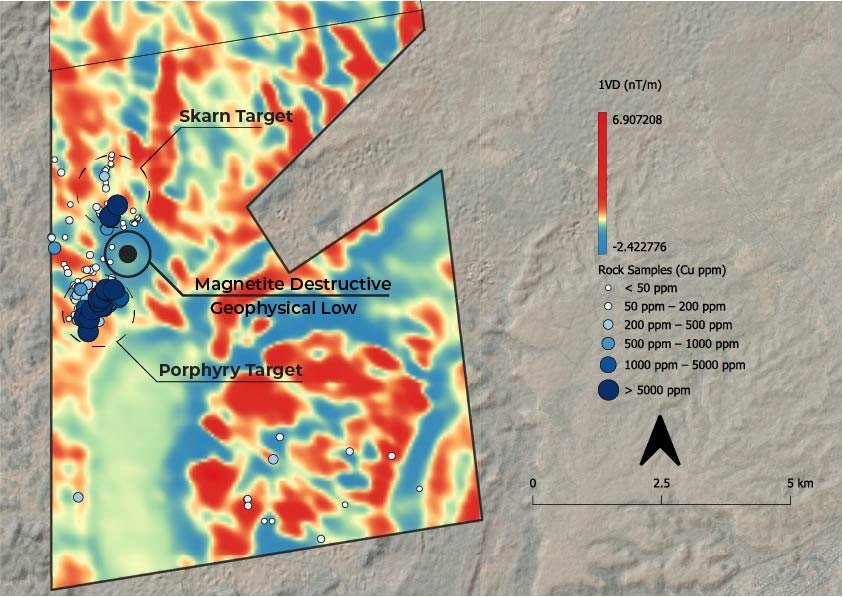
- Maiden drill programme at Bahila prospect (Al Amar) on track for early Q3 2026 – testing a 1 km wide magnetic anomaly coincident with a potential porphyry-style molybdenum halo (43 samples above 10 ppm Mo across ~8 km², peaking at 1,450 ppm Mo), flanked by 1 km of skarn (to the north) and 1 km of copper-bearing veins (to the southwest) at surface. Bahila sits adjacent to the Khnaiguiyah zinc-copper deposit (JORC resource of 73.5 Mt at 2.26% Zn, 0.20% Cu and 1.65% Mn per Ajlan & Bros.) in one of the Arabian Shield’s most endowed terranes.
- Extensive sampling and geophysics underway, with 915 rock samples and 298 stream-sediment samples now collected across our licences. 425 km2 ground magnetic survey nearing completion over six Ad Dawadimi licences; 104-line km IP and 405 line km radiometric survey underway at Bahila covering 20 km2; hyperspectral analysis underway across Ad Dawadimi and Al Amar covering 13,000 km2 regionally.
- 2.8 km of epithermal strike mapped at Halit (Ad Dawadimi) across two distinct vein systems – consistent with a multi-centre epithermal field.
- Trenching results up to 1.7% Cu at Saffakah (Ad Dawadimi), with surface rock chips to 4.9% Cu.
- Rock chip samples up to 1.5% Cu over a 2.5 km strike at Rayn (Al Amar), with numerous samples above 1% Cu.
- Exploration Enablement Programme agreement signed with the Ministry, qualifying 15 of 25 licences – the maximum permitted – and providing rebates of up to US$20M against eligible exploration spend. First annual rebate expected by year-end.
- Eurasian Resources Group (ERG) joins as a shareholder with a 9.9% stake, completing the final term of the licence-package purchase agreement.
1. The Saudi Opportunity: A Reminder
The Arabian-Nubian Shield (ANS) is one of the world’s most prospective and underexplored mineral belts. The 630,000 km² Precambrian province hosts the same family of gold, copper and base-metal deposit styles found in tier-one analogues such as the Abitibi and Birimian belts. The eastern side of the ANS in Saudi Arabia holds an estimated US$2.5 trillion in untapped mineral wealth, yet still remains largely untested by modern exploration techniques.
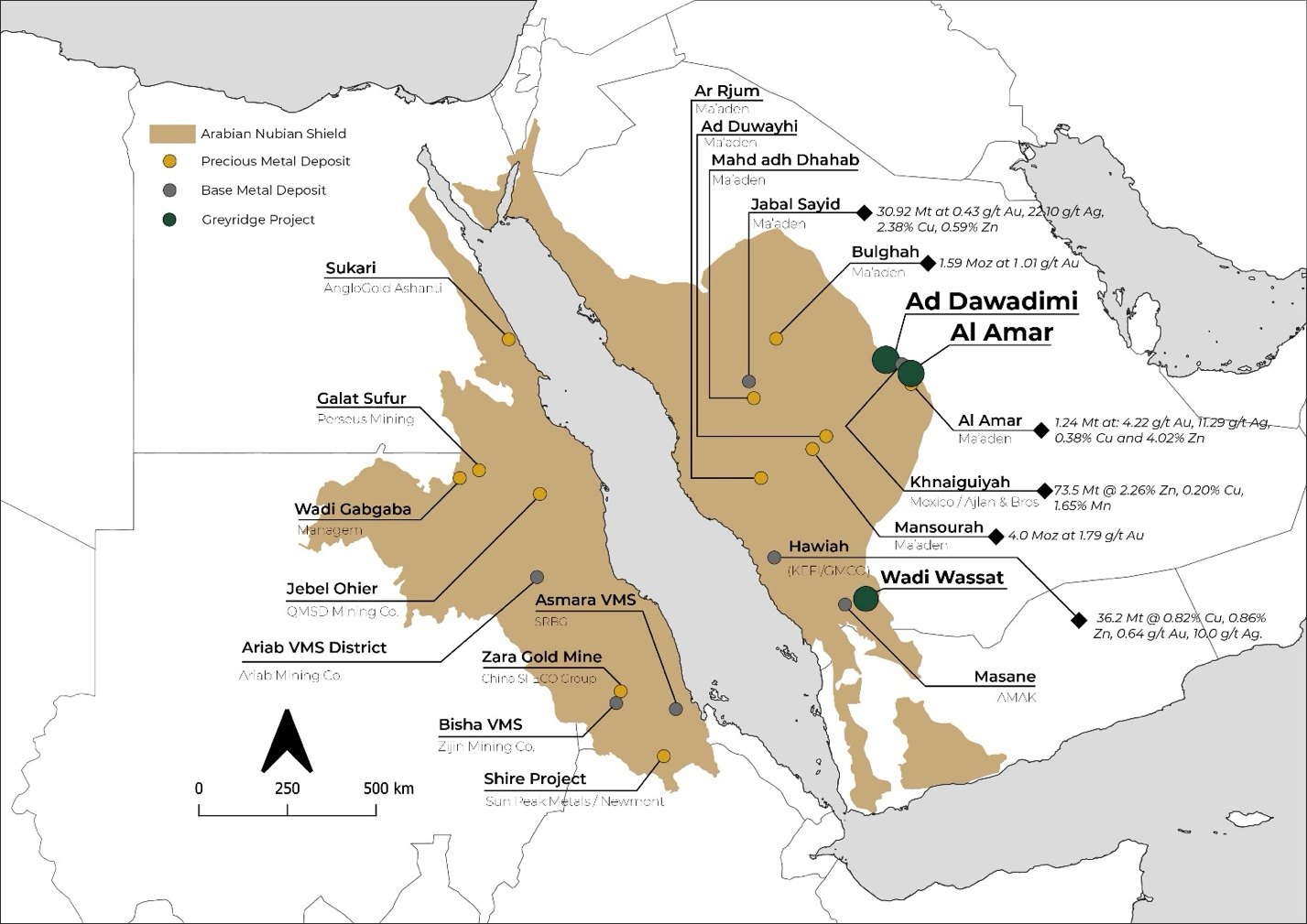
Gold and base-metal mineralisation in the Arabian Shield falls into three principal styles: 1) volcanogenic massive sulphide (VMS) deposits with associated epithermal precious and base metal mineralisation in volcano-sedimentary sequences; 2) epithermal vein and porphyry-related systems in arc settings; and 3) structurally controlled orogenic gold linked to the Najd Fault System and major terrane-bounding sutures. Greyridge's portfolio has exposure across all three deposit styles.
The global commodity backdrop reinforces the opportunity. Gold has been trading over US$4,000 per ounce, sustained by persistent global demand, while copper continues to rally against the backdrop of declining mine supply and increasing demand from electrification, artificial intelligence and defence. Western governments and capital providers are increasingly seeking alternatives to China for critical-metal supply, placing a premium on jurisdictions like Saudi Arabia that are both geologically prospective and politically aligned with the West.
The Kingdom has converted that geological endowment into one of the fastest-growing mining jurisdictions in the world. Saudi Arabia now ranks 10th globally on the Fraser Institute Investment Attractiveness Index – rising 94 positions since 2013 – and 4th globally on the strength of its regulatory framework. Annual exploration spend grew at a compound rate of approximately 50% between 2020 and 2024, far outpacing the global average of 6–8%, while exploration spend per kilometre rose five-fold to ~US$6,400/km²over the same period. Since 2019, the number of exploration licences issued annually has increased five-fold. Today, the Kingdom has 1,178 exploration licences and 296 exploitation licences, while more than US$45 billion in investment has been attracted since the launch of the new mining code. The number of exploration companies active in-country has risen from six in 2020 to ~240 today, including majors such as Barrick, Ivanhoe Electric, Zijin, Vedanta, Ma’aden and McEwen.
Greyridge is the largest foreign holder of exploration licences in the Kingdom. The position was built through the Company’s acquisition of Eurasian Resources Group’s (ERG) Saudi exploration platform in 2024. ERG had invested ~US$8 million building the in-country platform, securing ground and executing grassroots exploration.
Within this fast-growing market, Greyridge holds a position that is difficult to replicate today. We acquired our portfolio before the competition for exploration licences reached current levels. New entrants across successive tender rounds over the past 12 months have secured less prospective ground with materially higher expenditure commitments. With 25 licences covering 1,817 km² on and near defined copper, gold and VMS belts, Greyridge offers exposure to belt-scale exploration ground in one of the world’s top ten mining jurisdictions.
Source: Saudi Ministry of Industry and Mineral Resources, “KSA: Unlocking the Next Frontier of Discovery,” March 2026. Jurisdictional rankings and spend figures are as reported by the Ministry and have not been independently verified.
2. Portfolio Overview
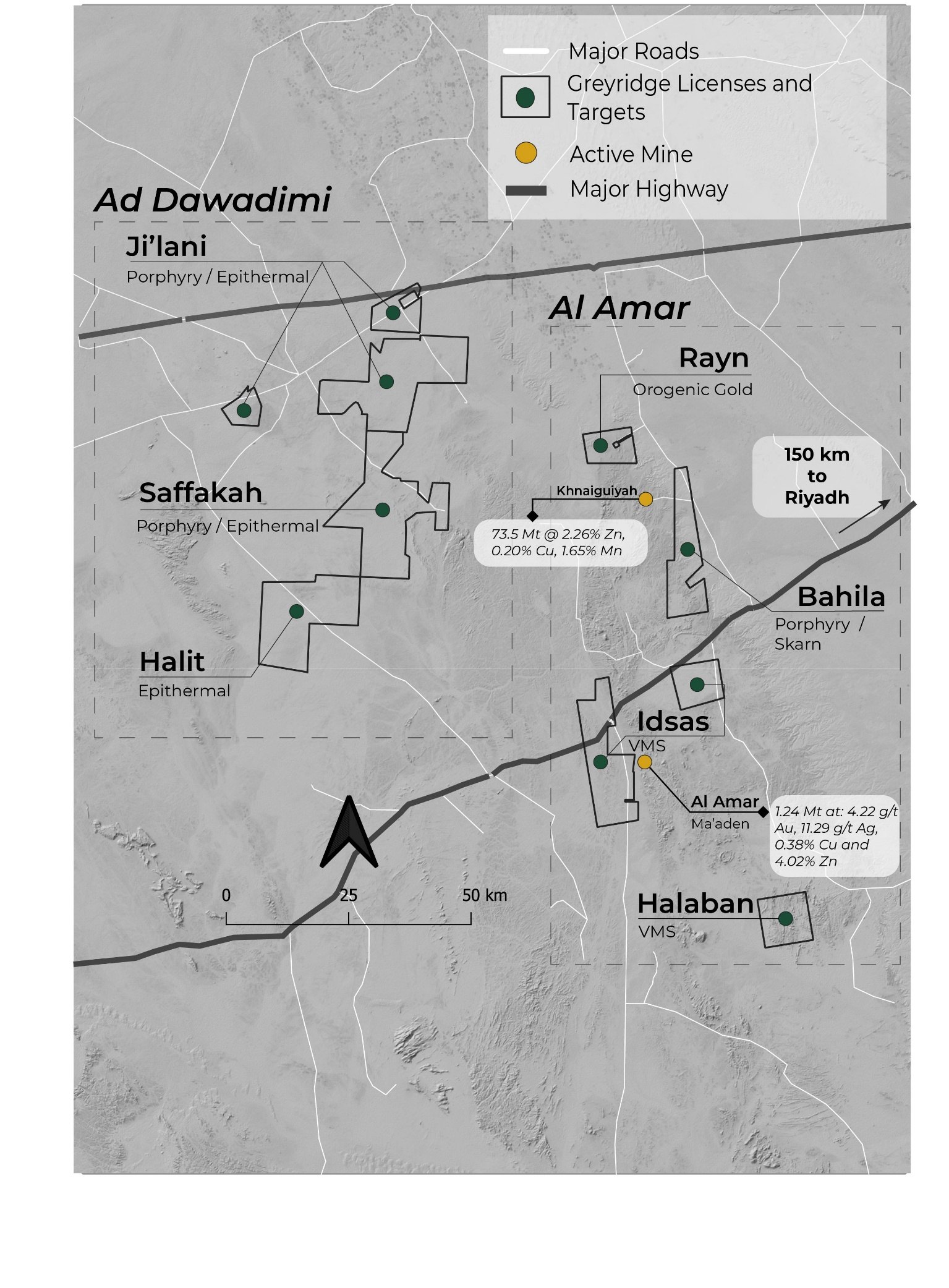
Greyridge’s 25-licence portfolio spans three project areas – Ad Dawadimi, Al Amar and Wadi Wassat – covering 1,817 km² of highly prospective ground with exposure to multiple deposit styles, including Cu-Au porphyry, epithermal gold, orogenic gold, skarn and VMS. As set out below, we have now introduced names for each prospective area on the projects.
| PROSPECT | PROJECT-LICENSE NUMBER | DEPOSIT STYLE |
|---|---|---|
| Halit | AD-038, AD-036, AD-037 | Epithermal |
| Saffakah | AD-029, AD-030, AD-031, AD-025, AD-035 | Porphyry Copper / Epithermal |
| Ji’lani | AD-023, AD-018, AD-019, AD-013, AD-014, AD-008 | Porphyry Copper / Epithermal |
| Rayn | AA-002 | Orogenic |
| Bahila | AA-005, AA-008, AA-012 | Porphyry Copper / Skarn |
| Idsas | AA-018, AA-20, AA-021, AA-024 | VMS / Orogenic |
| Halaban | AA-036 | VMS |
| Wadi Wassat | WW-009, WW-038 | VMS |
The portfolio is managed through a stage-gated funnel, with prospects advancing systematically from early conceptual work through to drill testing:
Concepts – earliest-stage holdings under initial geological interpretation.
Proof of Concept – a defined exploration thesis supported by geological, geochemical or geophysical evidence.
Prospect Delineation – a mineralized system identified, with work underway on its geometry, extent and controls.
Target Delineation – specific drill targets being defined through integrated datasets.
Target Testing – defined targets ready for the drill bit.
Advanced Exploration – the stage to which the highest-priority projects advance following successful drill results.
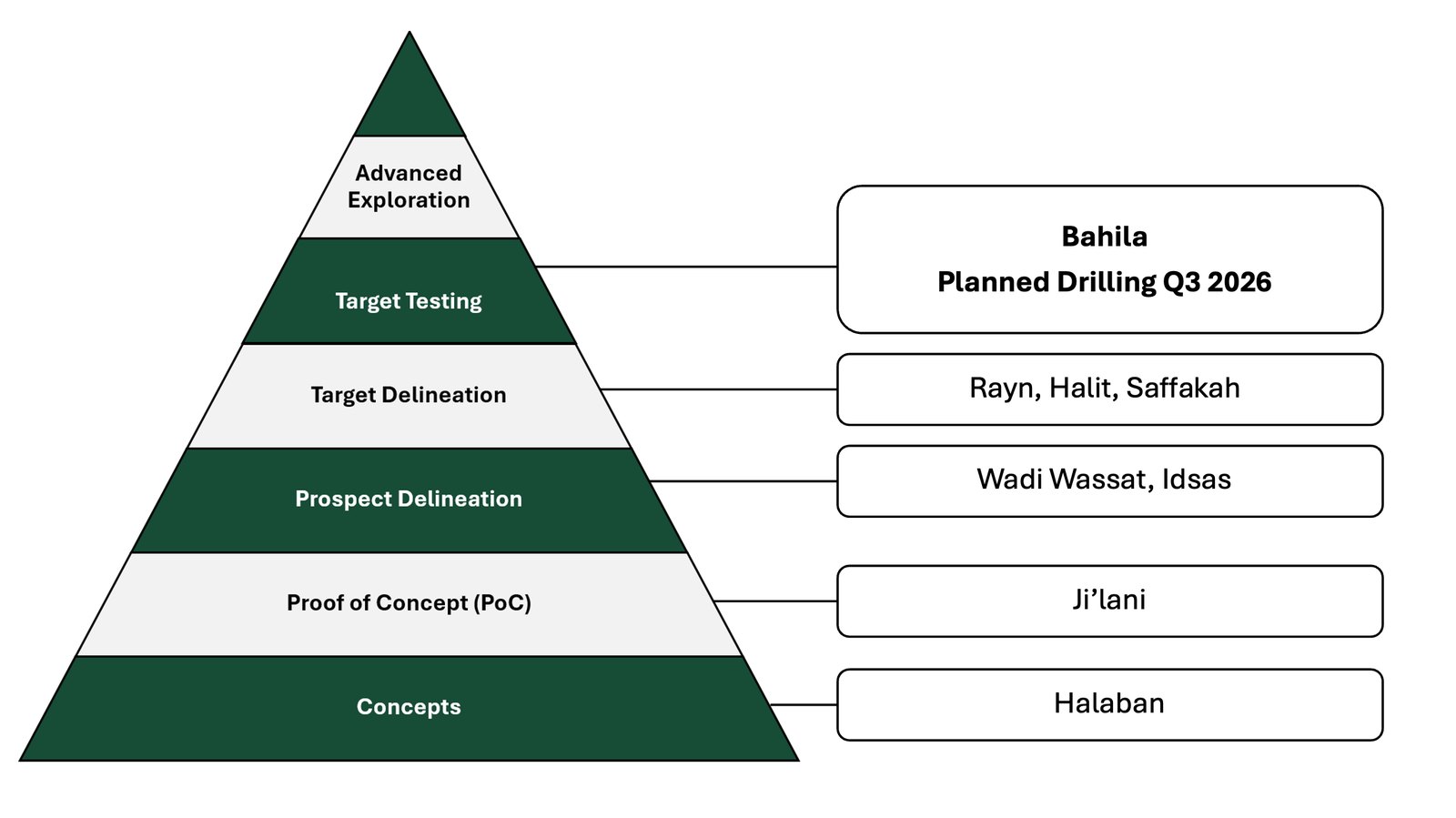
Seven prospects are currently active, with drilling expected to commence at Bahila in early Q3 2026 and a strong pipeline of earlier-stage prospects advancing behind it.
3. Prospects
The following four prospects have advanced to target-testing (drilling) and target delineation.
3.1 Bahila | Cu-Au Porphyry / Skarn | Target Testing (drilling early Q3 2026)
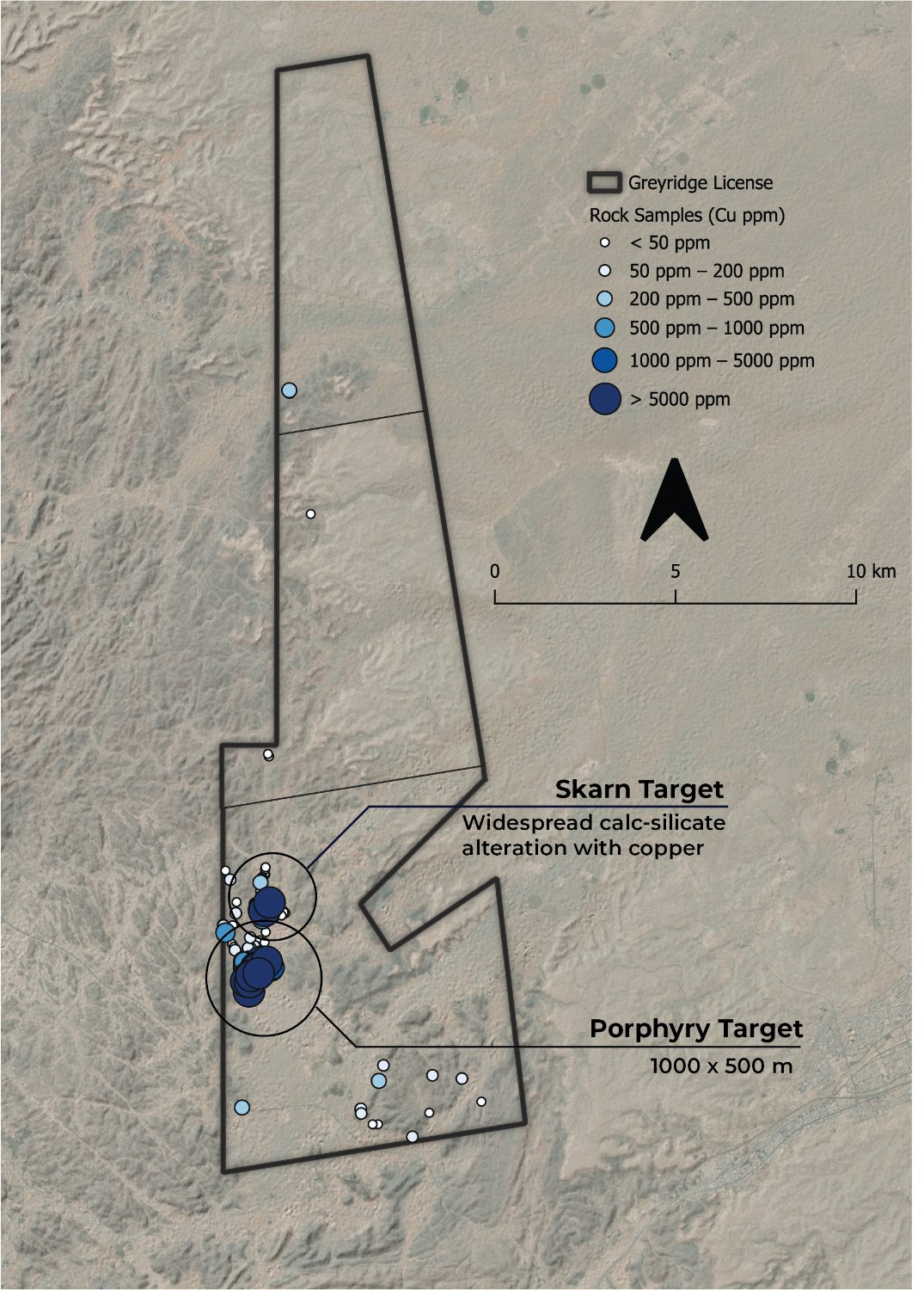
Bahila is the most advanced prospect in the portfolio and the focus of the Company’s maiden drill programme. Bahila currently comprises two targets at licences AA-12 and AA-20. Drilling at the AA-12 target (porphyry and skarn) will begin in early Q3 2026.
Why this matters
Bahila lies within the Ar Rayn terrane, interpreted as a Neoproterozoic continental-margin arc directly analogous to the Andean margin of Chile (Doebrich et al., 2007) – the setting that hosts the world’s largest porphyry copper and porphyry molybdenum deposits. The Bahila ground sits adjacent to the Khnaiguiyah zinc-copper deposit (JORC mineral resource of 73.5 million tonnes grading 2.26% Zn, 0.20% Cu and 1.65% Mn, containing approximately 1.66 Mt zinc, 145 kt copper and 1.21 Mt manganese), which may be inferred as being a distal part of the porphyry centre. The resource has tripled since the licence was awarded in 2022, with mine construction underway and production expected to commence in 2028. Ma’aden’s producing Al Amar gold-zinc-copper mine lies approximately 35 km to the southeast of Bahila. Greyridge’s ground potentially covers the porphyry source itself – the part of the system that is rarely available and that anchors the value of a discovery.
Key observations
- A porphyry-style molybdenum halo, with 43 rock samples above 10 ppm Mo across an ~8 km² footprint, with a coherent ~2.5 km × 1 km core of 14 samples above 50 ppm Mo, peaking at 1,450 ppm Mo. A molybdenum signature of this scale and continuity is the geochemical fingerprint of a porphyry centre, and is the single most distinctive feature of the target.
- A 1 km-diameter magnetite-destructive geophysical low, interpreted as a buried porphyry source intrusion and spatially coincident with the molybdenum core. The magnetite destruction is consistent with phyllic-to-potassic hydrothermal alteration extending to 500–800 m depth.
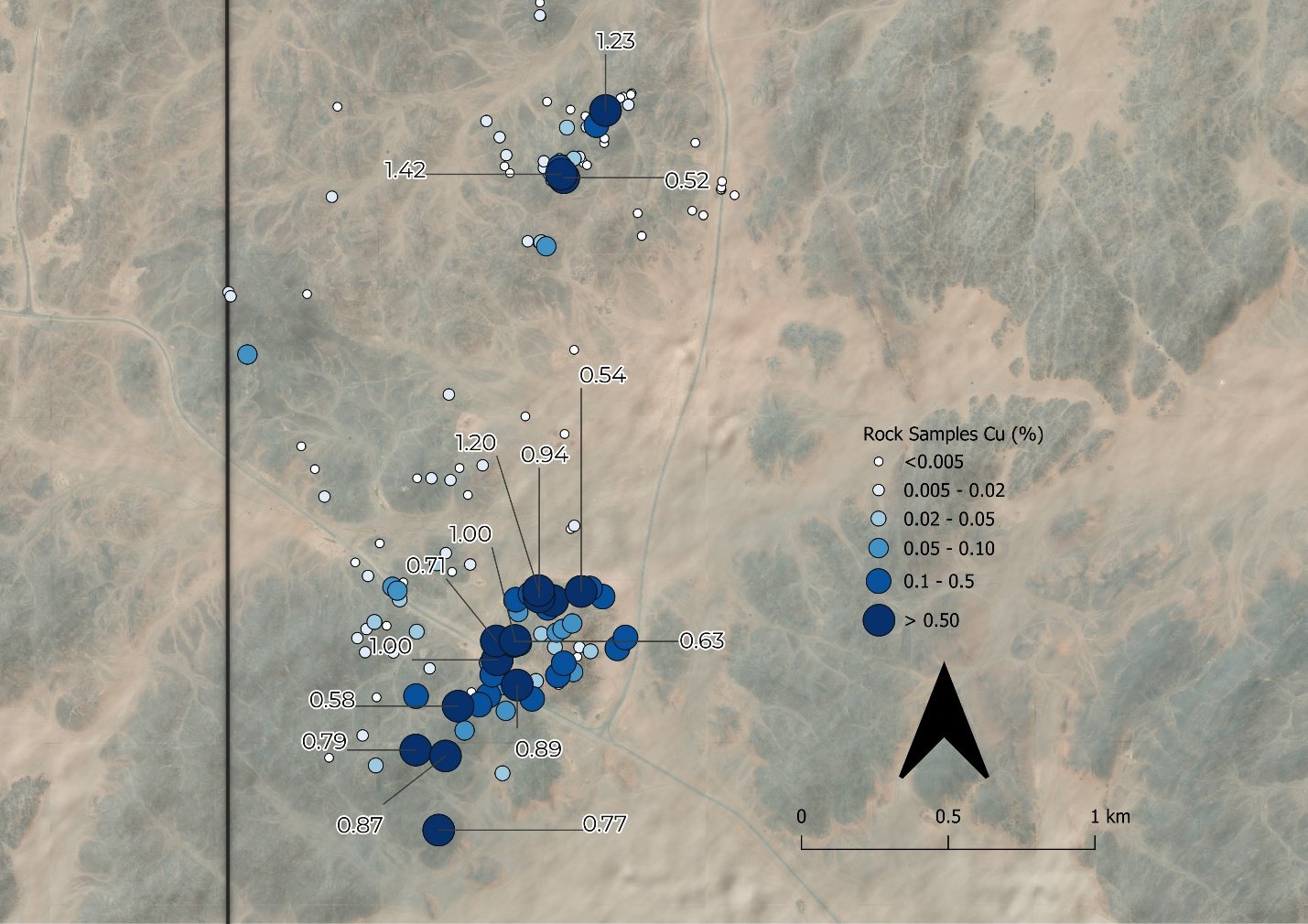
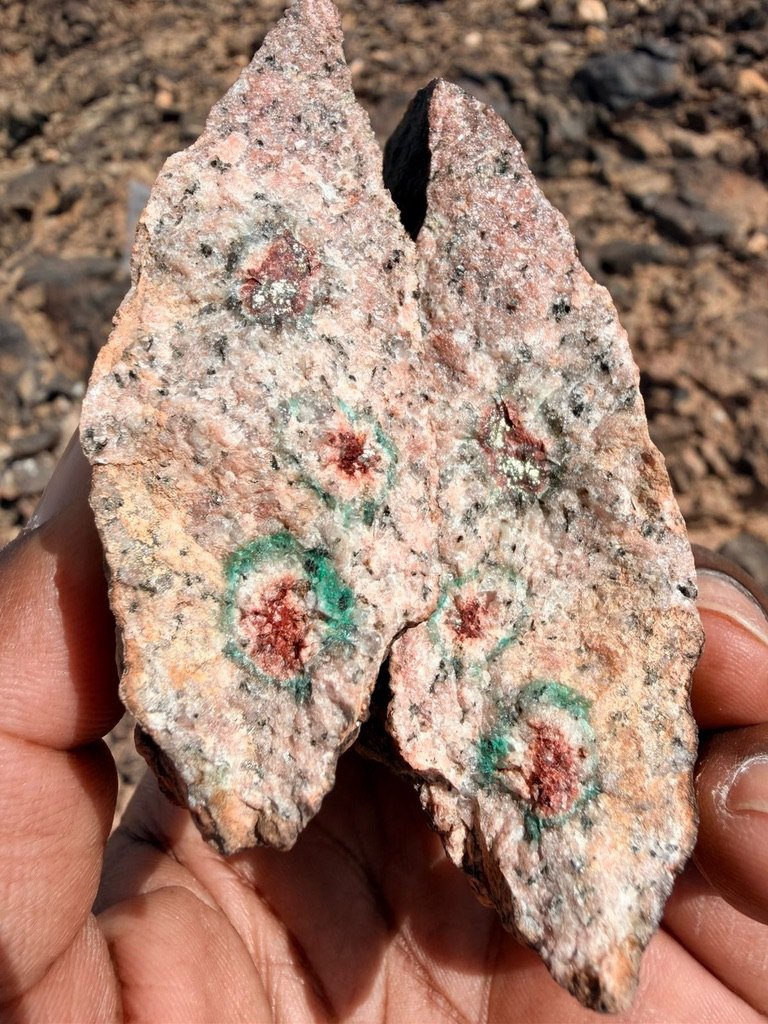
- 500 m strike of copper-iron-oxide quartz veining at surface, with a core copper zone over a 1 km strike and numerous samples above 1% Cu (to 1.42% Cu).
- 1 km strike of garnet-diopside prograde skarn developed north of the magnetic low, with retrograde epidote-actinolite-clay overprinting – an assemblage commonly associated with economically mineralized copper-gold skarn systems and a recognised peripheral facies of porphyry centres.
Hypothesis
The prospect exhibits textbook indications of the surface-to-subsurface footprint of a porphyry Cu-(Mo-Au) system: a molybdenum halo and magnetite-destructive low marking a buried intrusive centre, ringed by prograde-to-retrograde skarn and copper-bearing veins as its near-surface expression. The working hypothesis is that the magnetic low represents a fertile, buried porphyry intrusion, with the skarn and veins its peripheral signature. The molybdenum-dominant geochemistry suggests a Mo-rich porphyry affinity emplaced in a post-collisional setting on the Al Amar Fault Zone. Drilling in early Q3 2026 will directly test this hypothesis.
Bahila also hosts a copper-gold target approximately 20 km south of the porphyry/skarn target at AA-20, with 27 rock chip samples collected in 2026 awaiting assay results. The copper-gold association observed at surface may indicate a proximal mineralizing source. Infill sampling, structural mapping and alteration mapping are ongoing.
Next steps
- Complete IP and radiometric survey (Simcoe Geoscience) to finalise drill targets (Q2 2026).
- RC and diamond drilling (Golden Compass) of the porphyry/skarn target at AA-12 (early Q3 2026).
- 13,000 km2 supporting remote sensing (Aster Funds), 200 stream-sediment samples and further mapping at the AA-20 copper-gold target (Q3 2026).
3.2 Halit | Epithermal | Target Delineation
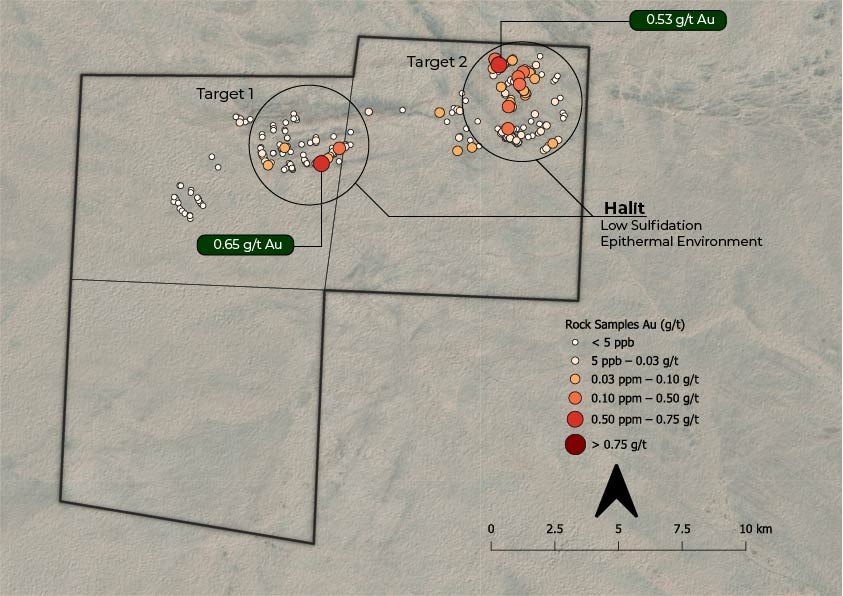
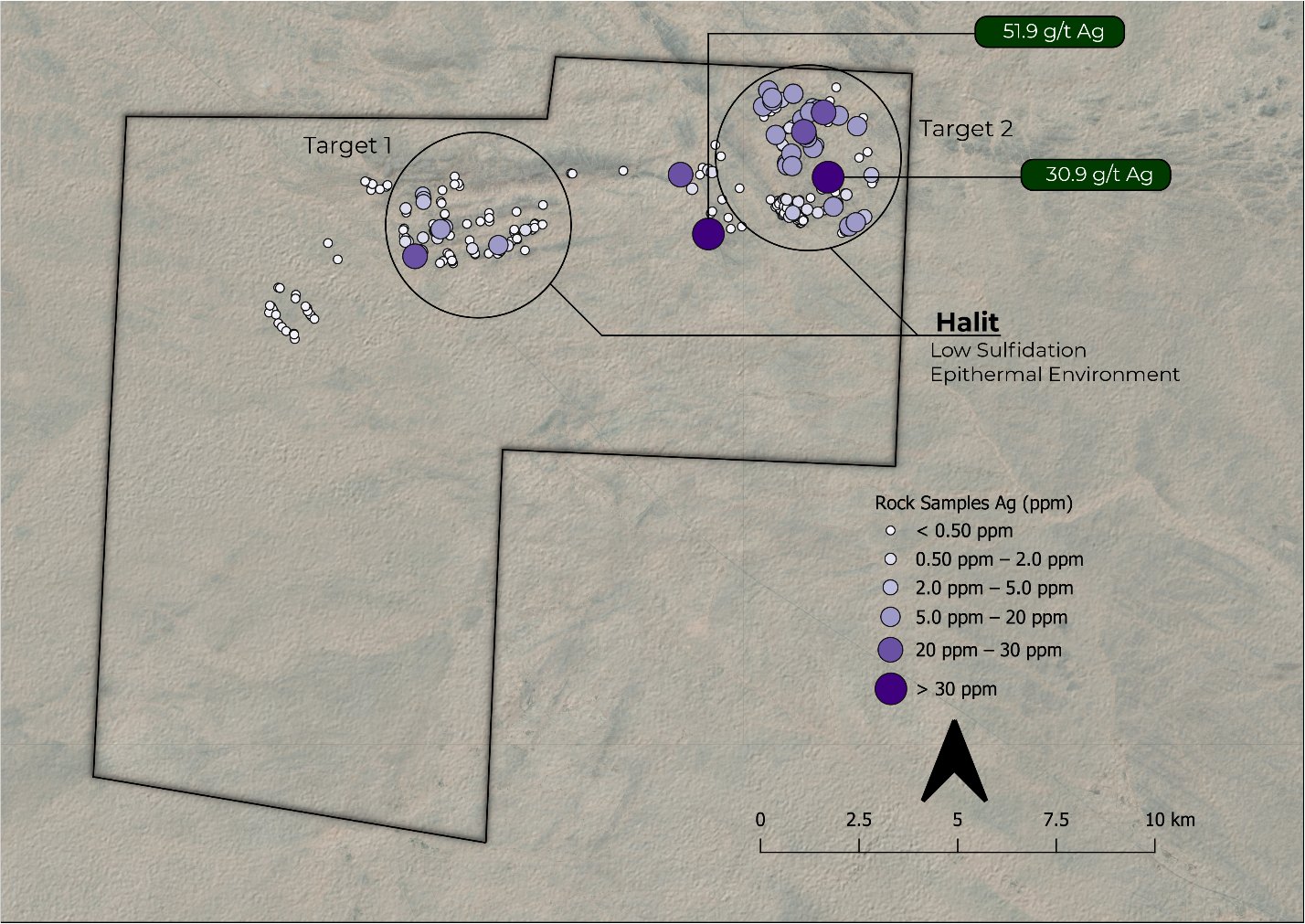
Halit is an epithermal prospect comprising two targets at licences AD-36 and AD-37.
Key observations
- Target 1 (AD-36): a 2 km strike length of epithermal vein stockwork with chalcedonic and crustiform quartz textures and pervasive sericite alteration – textures characteristic of well-preserved low- to intermediate-sulfidation epithermal systems, with 118 rock chip samples collected to date.
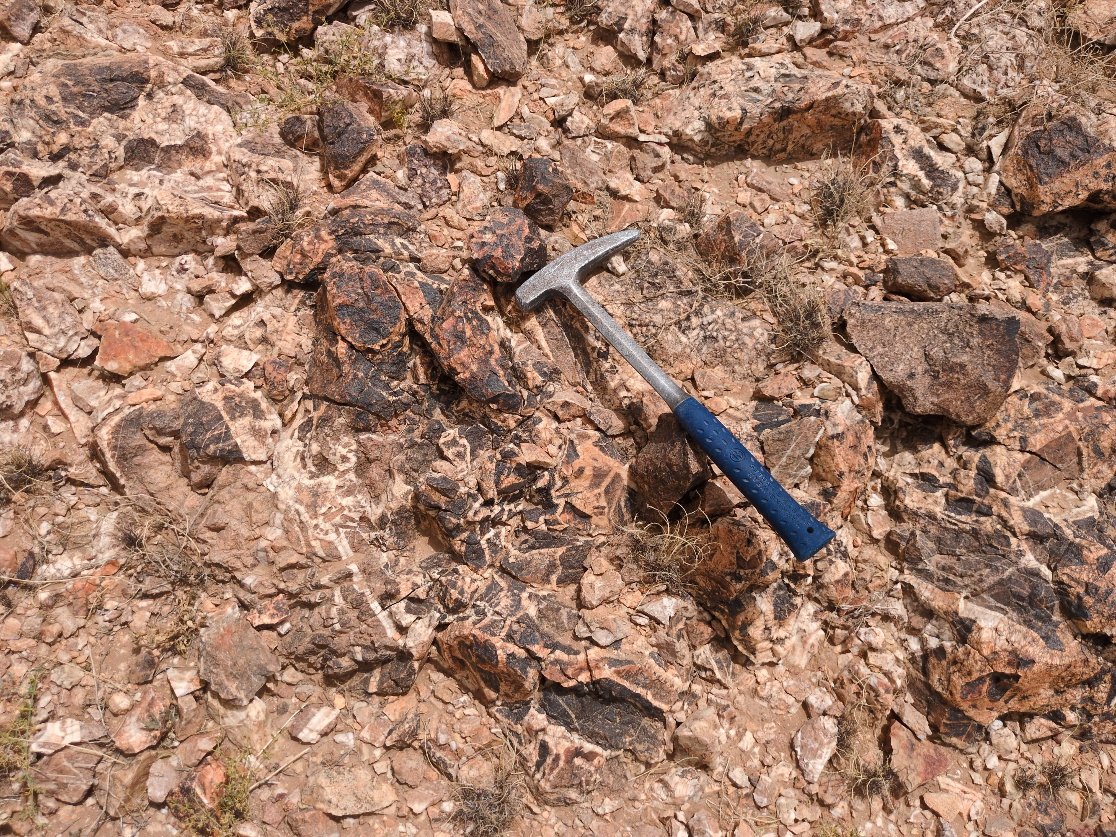
- Target 1 (AD-36): High-level low sulfidation epithermal textures (cockade breccias / colloform veining) are preserved at surface defining an intact and preserved mineralized epithermal system
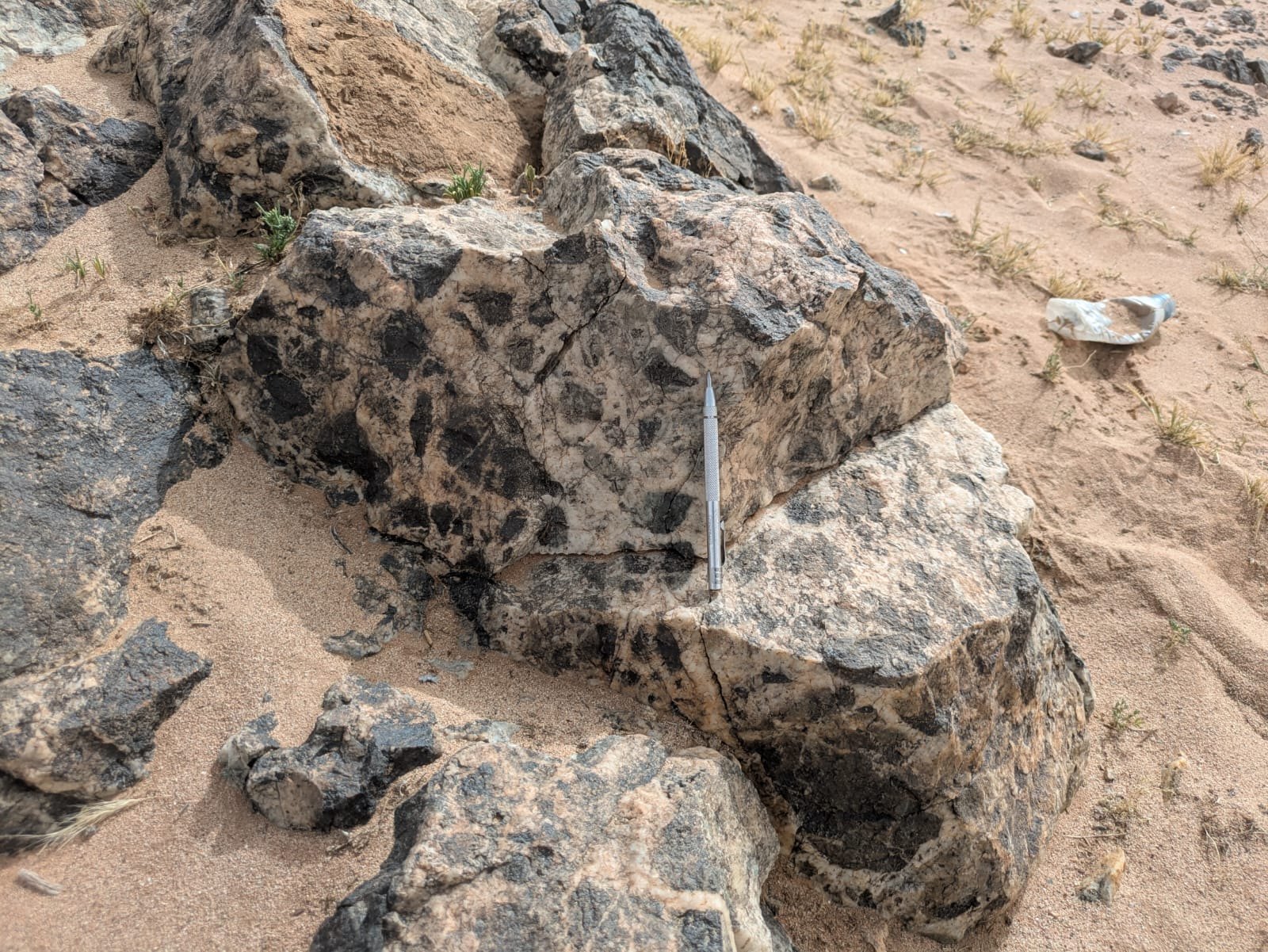
- Target 2 (AD-37): an 800 m strike length of epithermal quartz veining with phyllic (quartz-sericite-pyrite) alteration – an assemblage commonly associated with the upper portions of gold-bearing epithermal and porphyry systems, with 152 rock chip samples collected to date.
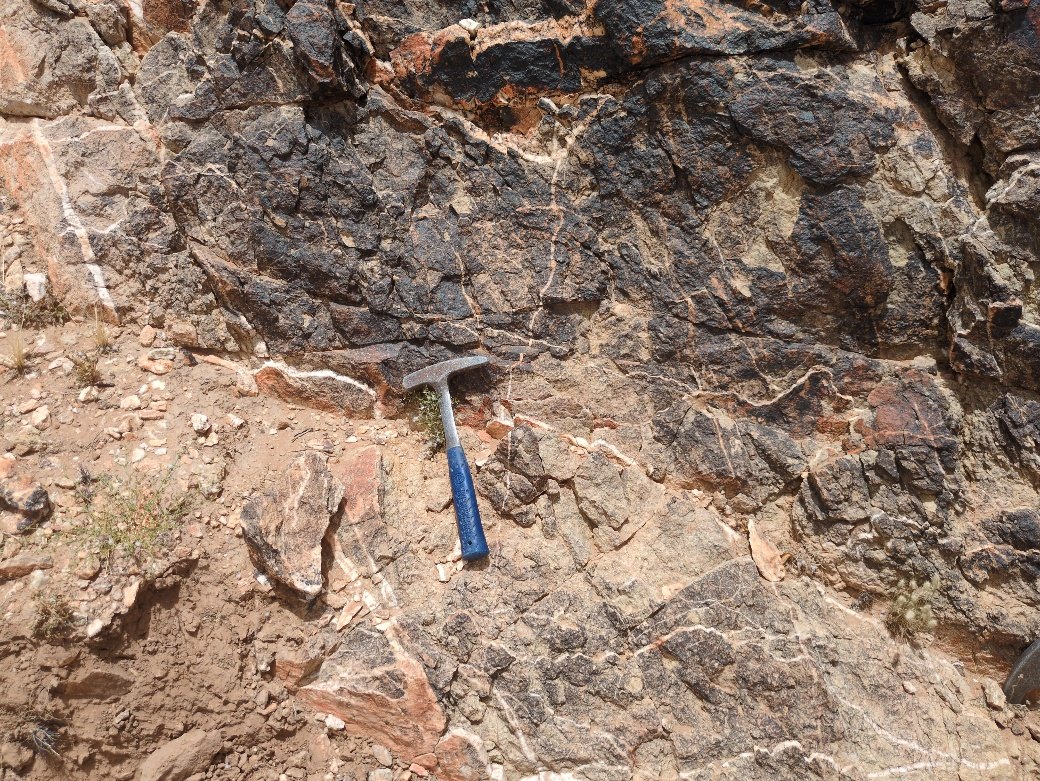
- Assays up to 0.53 g/t Au, with numerous assays pending from the most recent field programmes.
Hypothesis
Two distinct epithermal targets separated by mapped strike (13 km) – one with chalcedonic and crustiform vein textures, the other with phyllic alteration – is consistent with a multi-centre low-sulfidation epithermal district rather than an isolated vein occurrence. The textures and alteration point to a well-preserved system, with classic QSP alteration at Target 2 suggesting the upper portion of a deeper, potentially porphyry-related hydrothermal system.
Next steps
- Comprehensive infill rock chip sampling across both targets.
- ASTER / hyperspectral remote sensing to refine alteration patterns.
- Structural mapping to define vein continuity, followed by drill targeting.
3.3 Rayn | Target Delineation
Rayn is an orogenic prospect at licence AA-02.
Key observations
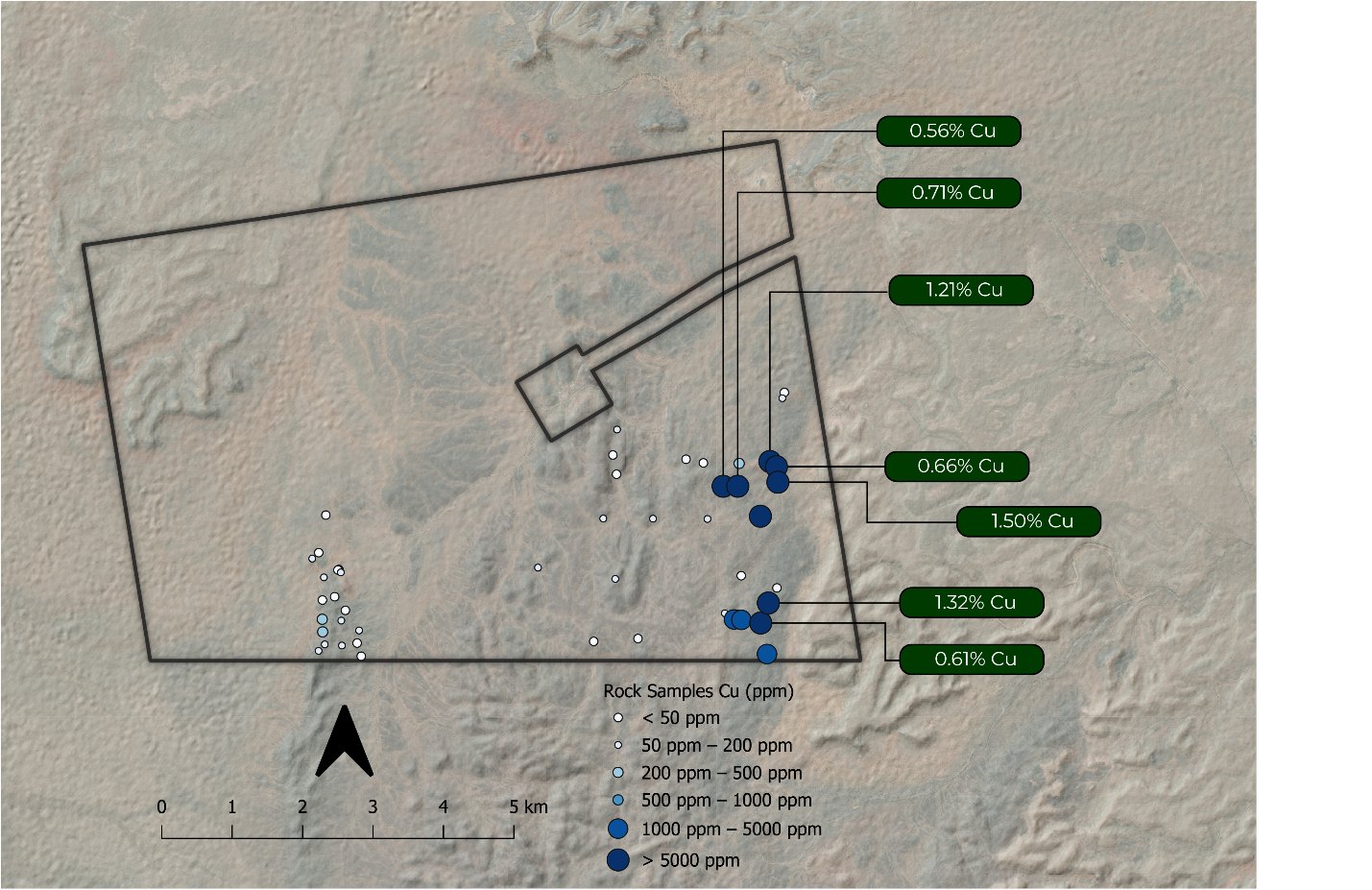
- 700 m of orogenic quartz veining mapped along strike on the western side of the licence.
- Multiple samples above 1% Cu (to 1.5% Cu) on the eastern side of the licence, with a copper-gold association at surface over a 2.5km corridor suggesting a proximal mineralizing source.
Next steps
- Infill rock chip sampling and structural mapping along the vein corridor.
- Ground geophysics (IP / magnetics) to define target geometry.
3.4 Saffakah | Cu-Au Porphyry / IOCG | Target Delineation
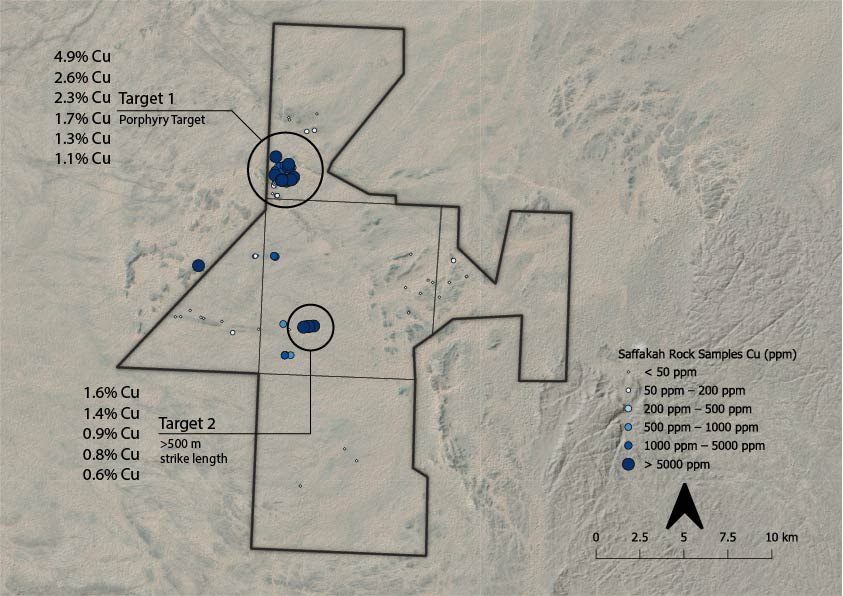
Saffakah hosts two potential porphyry / magmatic-hydrothermal targets, at licences AD-25 and AD-30.
Key observations
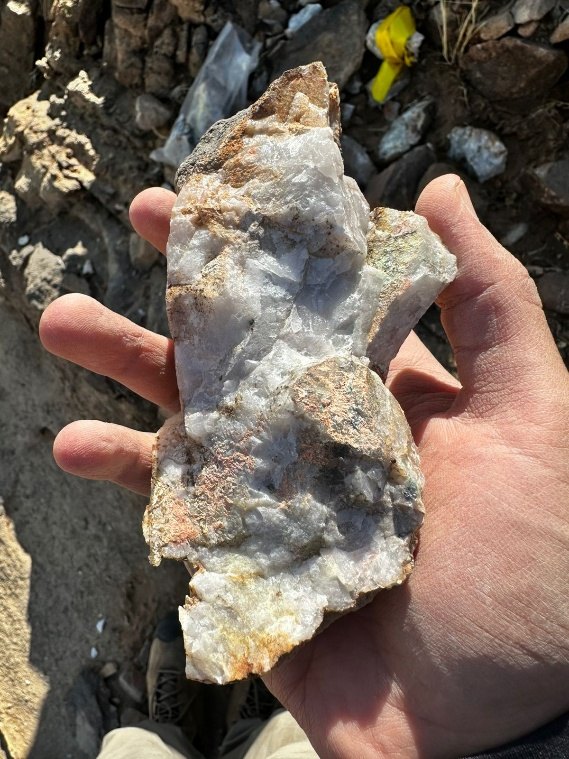
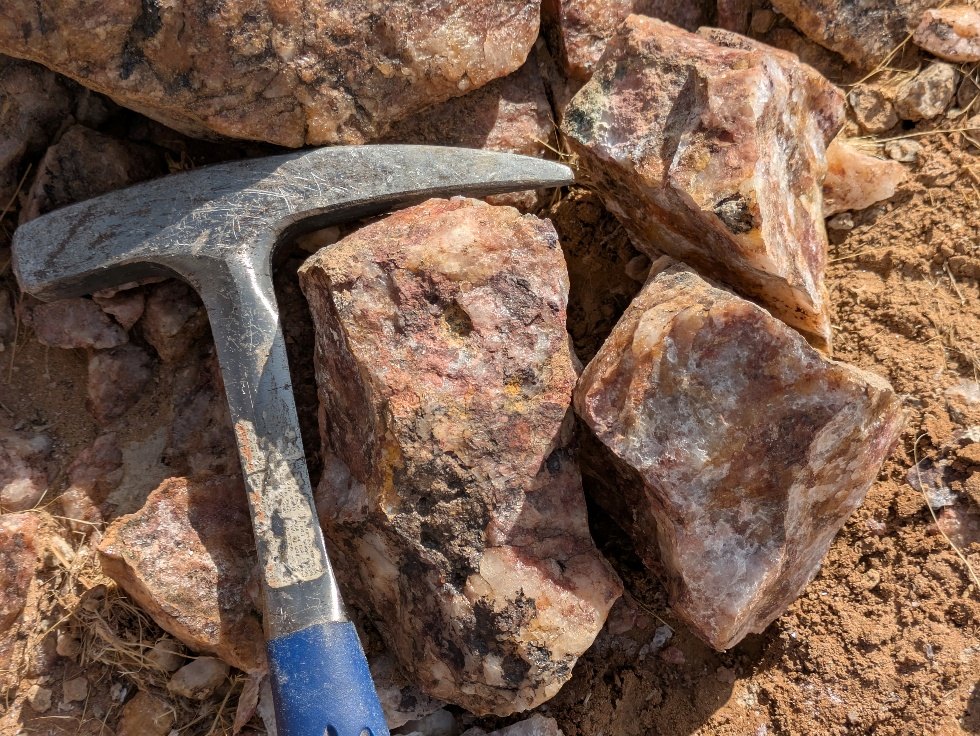
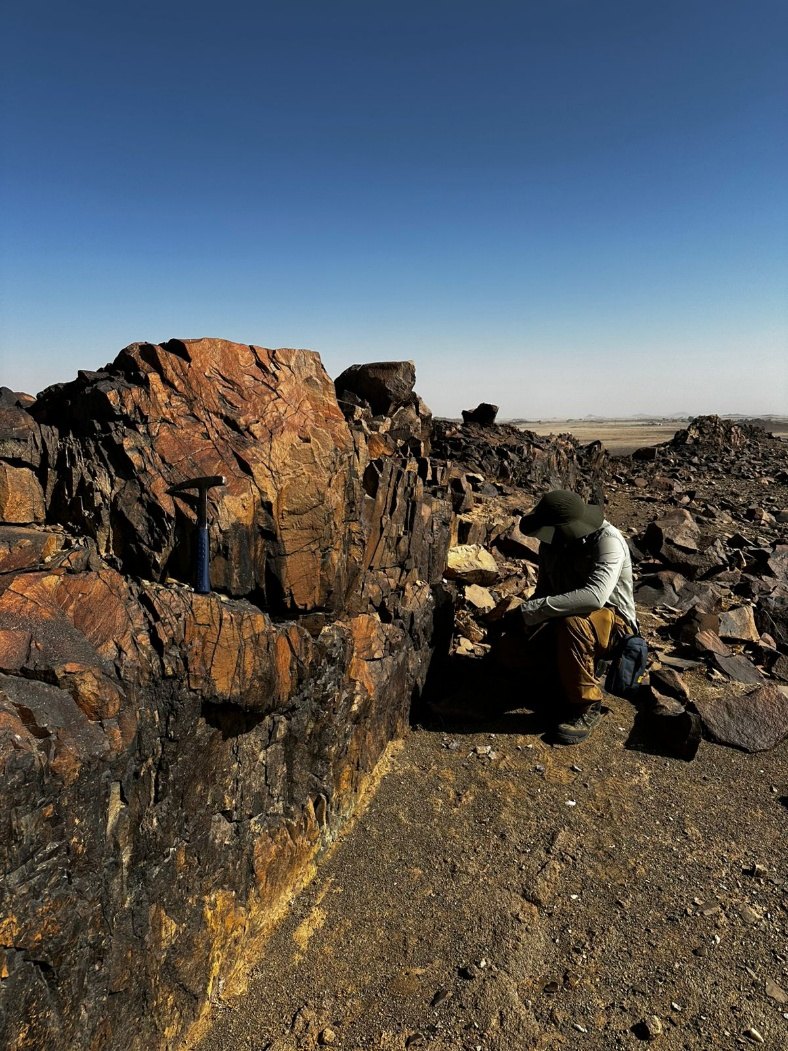
- Target 1 (AD-25): surface grades to 4.9% Cu, with 195 samples over a 12 km2 area, numerous samples above 0.5% Cu across a 1 km × 1 km zone and expansion potential into the untested outer ridges.
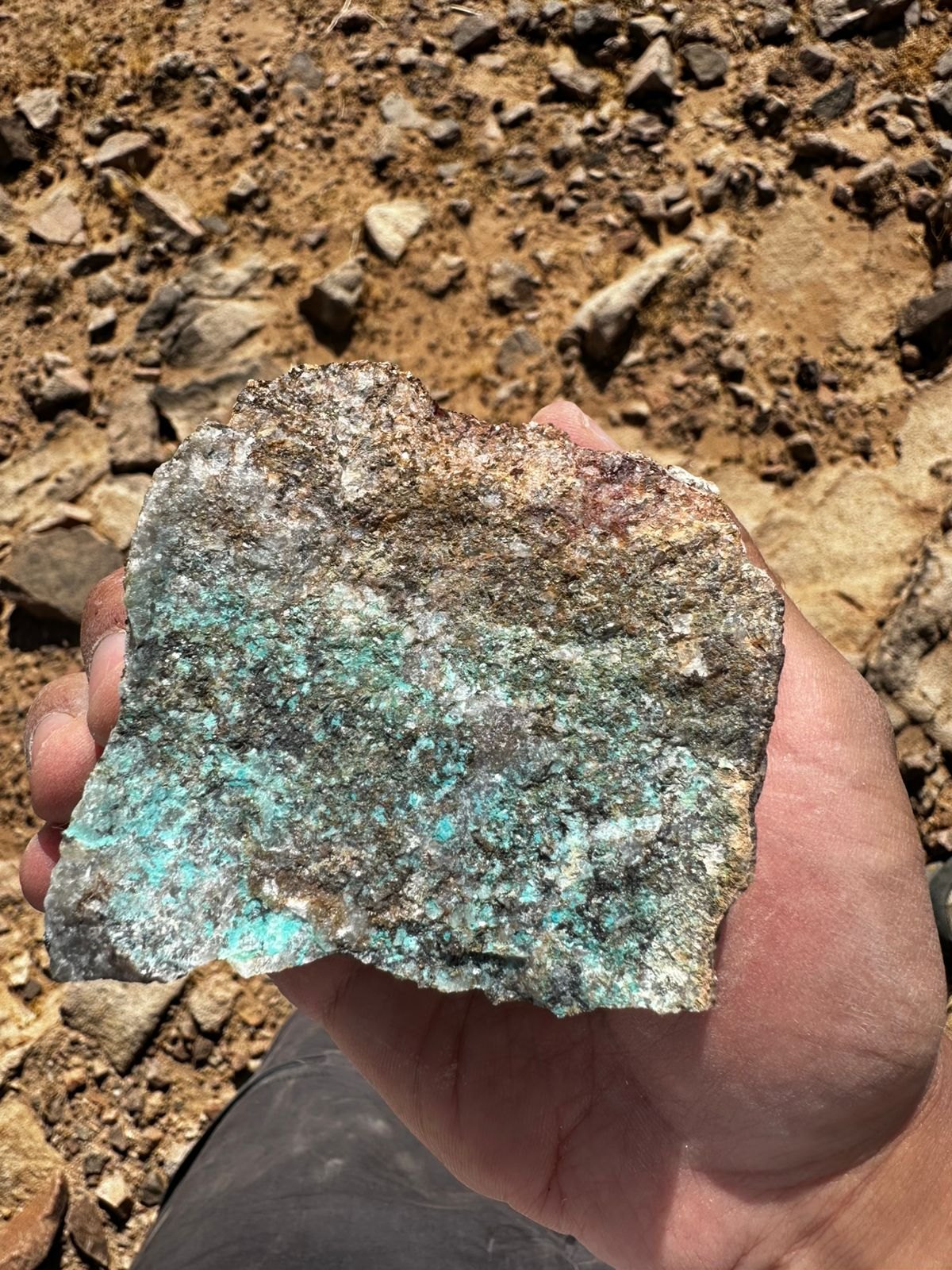
- Target 2 (AD-30): a >2 m-wide, 330 m long, monzonitic dyke mapped, sampled and correlated to copper occurrences in adjacent blocks, with malachite along chilled margins and trench samples to 1.7% Cu.
- K-Na metasomatism with magnetite and hematite-muscovite alteration providing a possible IOCG / Porphyry geochemical signature across the AD-30 target.
Hypothesis
This area may sit in a possible back-arc basin that developed adjacent to an active magmatic arc, a setting capable of hosting both porphyry-style and IOCG-style mineralization in close proximity. Ongoing arc magmatism to the front of the basin generated oxidized, metal-rich fluids typical of porphyry Cu-Au-Mo systems, while extension within the back-arc basin itself thinned the crust, increased heat flow, and created deep structural pathways for large-scale brine circulation, the conditions that drive IOCG formation. The result is a district where two distinct but complementary mineralizing systems, one arc-driven and one extension-driven, occur side by side along the same crustal structures.
Next steps
- Infill geochemical sampling across the outer ridges (Q3 2026).
- Stream-sediment surveys to test expansion potential (Q3 2026).
- Integrate ground magnetic data (Argas) with surface geochemistry to refine drill targets (Q3 2026).
4. Prospect Pipeline
Alongside work on the advanced prospects, reconnaissance and target generation work is continuing across the wider portfolio. Current early-stage prospects include:
- Wadi Wassat | VMS – sampling and mapping programme ongoing at licences WW-09 and WW-38.
- Ji’lani | Cu porphyry and epithermal gold – preliminary work completed; further mapping and sampling planned for Q3 2026.
- Idsas | VMS and Orogenic gold – adjacent to Ma’aden’s Al Amar mine; preliminary work completed, with additional mapping and sampling planned for Q3 2026.
- Halaban| VMS – preliminary work completed; further mapping and sampling planned for Q3 2026.
5. Catalyst Calendar
Greyridge will continue to advance its structured, multi-phase exploration programme through 2026 and into 2027, with activity sequenced to systematically de-risk prospects ahead of drilling. The next twelve months carry a dense and well-defined sequence of value catalysts, beginning with the imminent completion of ongoing geophysics at Bahila ahead of the Company’s maiden drill programme in early Q3 2026.
| Timing | Catalyst | Prospect / Programme |
|---|---|---|
| Q2 2026 | IP and radiometric survey completed; drill targets finalized Magnetic survey over six licences at Ad Dawadimi completed | Bahila (AA-12) Saffakah, Halit (AD025, AD029, AD030, AD037, AD031, AD035) |
| Early Q3 2026 | Maiden drill programme commences – RC and diamond drilling | Bahila (AA-12) |
| Q3 2026 | Four prospects advancing through delineation; Wadi Wassat field programme ongoing | Rayn, Halit, Saffakah, Wadi Wassat |
| Q4 2026 | First maiden drill assay results expected; second prospect advanced to drill-ready | Bahila (AA-12) Halit (AD-36/-37) |
| December 2026 | First annual EEP rebate expected | Corporate |
| 2027 | Follow-up drilling; third prospect advanced to drill-ready | Portfolio |
| 2026 | |||||||||
|---|---|---|---|---|---|---|---|---|---|
| Work type | Q2 | Q3 | Q4 | ||||||
| Apr | May | Jun | Jul | Aug | Sep | Oct | Nov | Dec | |
| Bahila (AA-12) Geophysics, drilling, assays | |||||||||
| Saffakah, Halit Magnetic survey, delineation, mapping and sampling | |||||||||
| Wadi Wassat Field programme | |||||||||
| Rayn Target delineation | |||||||||
| Portfolio EEP rebate | |||||||||
| Legend | Active phase | Ongoing / Background Work | Discrete milestone |
|---|
Timing reflects current expectations. See the forward-looking-information statement at the end of this update
6. Corporate Update
Exploration Enablement Programme (EEP)
The EEP is a Saudi government rebate scheme that co-funds early-stage exploration. As announced in our March 2026 shareholder update, Greyridge qualified for the EEP across 15 of its 25 licences – the maximum permitted under the programme. The EEP provides for rebates of up to US$20 million (SAR 75 million), materially increasing the impact of every dollar spent on exploration and providing a multiplier effect on every dollar invested in the Company. The award is a clear signal of government confidence in the scale and prospectivity of Greyridge’s portfolio and team.
The Company formally signed the EEP framework agreement with the Ministry in March, activating the rebate scheme against eligible spend from October 2025. The Company’s first annual rebate is expected in December 2026.
ERG Joins the Shareholder Register
The Company is pleased to welcome Eurasian Resources Group (ERG) as a shareholder, with a 9.9% holding in Greyridge Exploration (Canada). The interest was issued in early April 2026 to satisfy the final condition under the licence-package purchase agreement. ERG was one of the first major foreign mining groups to enter Saudi Arabia in 2022, securing high-quality ground, establishing the in-country team and building the foundational datasets underpinning Greyridge’s exploration programme.
AI-Led Targeting with VRIFY
Greyridge is pleased to recognise VRIFY as a technology partner. VRIFY brings leading geoscience and machine-learning expertise to exploration, with software used by more than 185 mining and exploration companies worldwide. VRIFY’s AI prospectivity-mapping platform (DORA) is now being applied to Greyridge’s portfolio, combining the Company’s proprietary data with Saudi government public data to guide fieldwork and identify targets. Greyridge will share outputs from this work in future updates as datasets and prediction models advance.
About Greyridge
Greyridge Exploration Corp. is focused on discovering copper and gold deposits on underexplored, highly prospective ground in Saudi Arabia. The Company holds 25 licences (1,817 km²) situated on and near defined gold and copper mineral belts of the Arabian-Nubian Shield.
Qualified Person
The scientific and technical information in this update has been reviewed and approved by Darren Lefort, a “Qualified Person” as defined under National Instrument 43-101 – Standards of Disclosure for Mineral Projects. Rock chip, channel and trench sample results referred to in this update are selective in nature and are not necessarily representative of the mineralisation hosted on the licences. Individual sample assays do not constitute mineral resources or mineral reserves as defined under NI 43-101 and CIM Definition Standards and should not be interpreted as indicative of grades or tonnages that may be defined by future drilling.
Forward-Looking Information
This update contains forward-looking information within the meaning of applicable Canadian securities legislation, including statements regarding planned exploration and drilling programmes, the timing and expected outcomes of geophysical surveys and drilling, interpreted geological and deposit models, the expected timing and amount of EEP rebates, and anticipated portfolio advancement. Forward-looking information is based on assumptions and is subject to known and unknown risks and uncertainties – including exploration risk, the inherent uncertainty of geological interpretation prior to drilling, commodity-price volatility, permitting, and contractor and assay-laboratory availability – that may cause actual results to differ materially from those expressed or implied. References to deposit-style analogues and to neighbouring deposits (including the Al Amar mine and Khnaiguiyah) are for geological context only; mineralisation hosted on, or grades and tonnages associated with, neighbouring properties are not necessarily indicative of mineralisation on Greyridge’s licences. Readers are cautioned not to place undue reliance on forward-looking information, which speaks only as of the date of this update. The Company undertakes no obligation to update forward-looking information except as required by law. Additional risk factors are described in the Company’s continuous-disclosure filings available on SEDAR+.