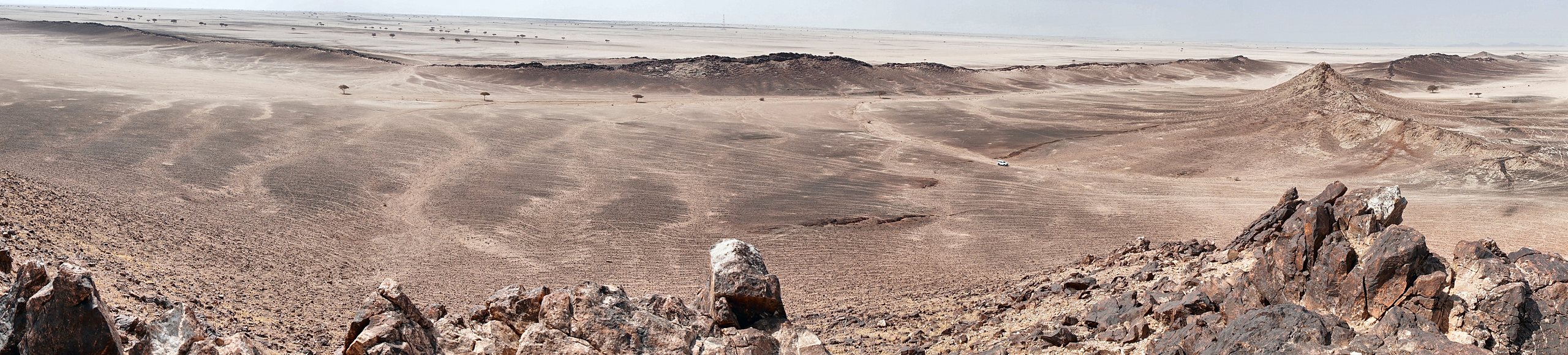
Halit
A zoned copper–zinc–silver system in a granitoid and porphyry complex, with two clusters about 10 km apart on an interpreted corridor.
At a glance
Scale and setting
- Project area
- Ad Dawadimi
- Licences
- AD-036, AD-037, AD-038 (about 280 km²)
- Deposit style
- Polymetallic: copper, zinc and silver
- Stage
- Target delineation
- Host rocks
- Granodiorite, granite and porphyry dykes of the Ad Dawadimi terrane
- Under way
- Trenching at AD-036 and AD-037
Target
A zoned copper–zinc–silver system
Halit hosts two mineralised clusters, at AD-036 and AD-037, centred about 10 km apart on an interpreted east-northeast corridor. The strongest copper comes from porphyritic granodiorite, porphyry dykes and intrusive contacts.
Rock chips record three metal associations, organised in space: copper with bismuth, tungsten and molybdenum in and beside the intrusive rocks; zinc, lead and silver in veins and gossans; and gold with arsenic and antimony at the northern edge of AD-037.
Of 560 rock chips collected October 2024 to June 2026.

Work completed
What we have done
- 560 rock chips assayed across AD-036, AD-037 and the area between them, October 2024 to June 2026.
- Detailed geological mapping of four areas, 3.4 km², in July and August 2026.
- Ground magnetic survey over AD-037 on 100 m lines.
- Petrography of key samples at King Abdulaziz University.
- Trenching: 1,140 m completed at AD-036, with assays at the laboratory; 2,228 m completed at AD-037, with excavation continuing.
Results
What the work has returned
- Copper in 53 rock chips at or above 0.1% Cu, ten of them above 0.5% Cu, to a peak of 1.49% Cu at an intrusive contact in south-eastern AD-037.
- A quartz-veined rhyolite porphyry at AD-037 returned 1.16% Cu, 4.96% Zn and 51.9 g/t Ag in one sample.
- At AD-036, copper with bismuth and tungsten in phyllic-altered porphyritic granodiorite, to 0.95% Cu.
- Gold in 16 rock chips at or above 0.1 g/t Au, to 0.66 g/t Au. Seven sit at the northern edge of AD-037, with arsenic, lead and antimony around an old pit.
- Copper and gold occur largely in different samples. Across AD-037, copper dominates in the south; gold, arsenic, zinc and lead rise to the north.
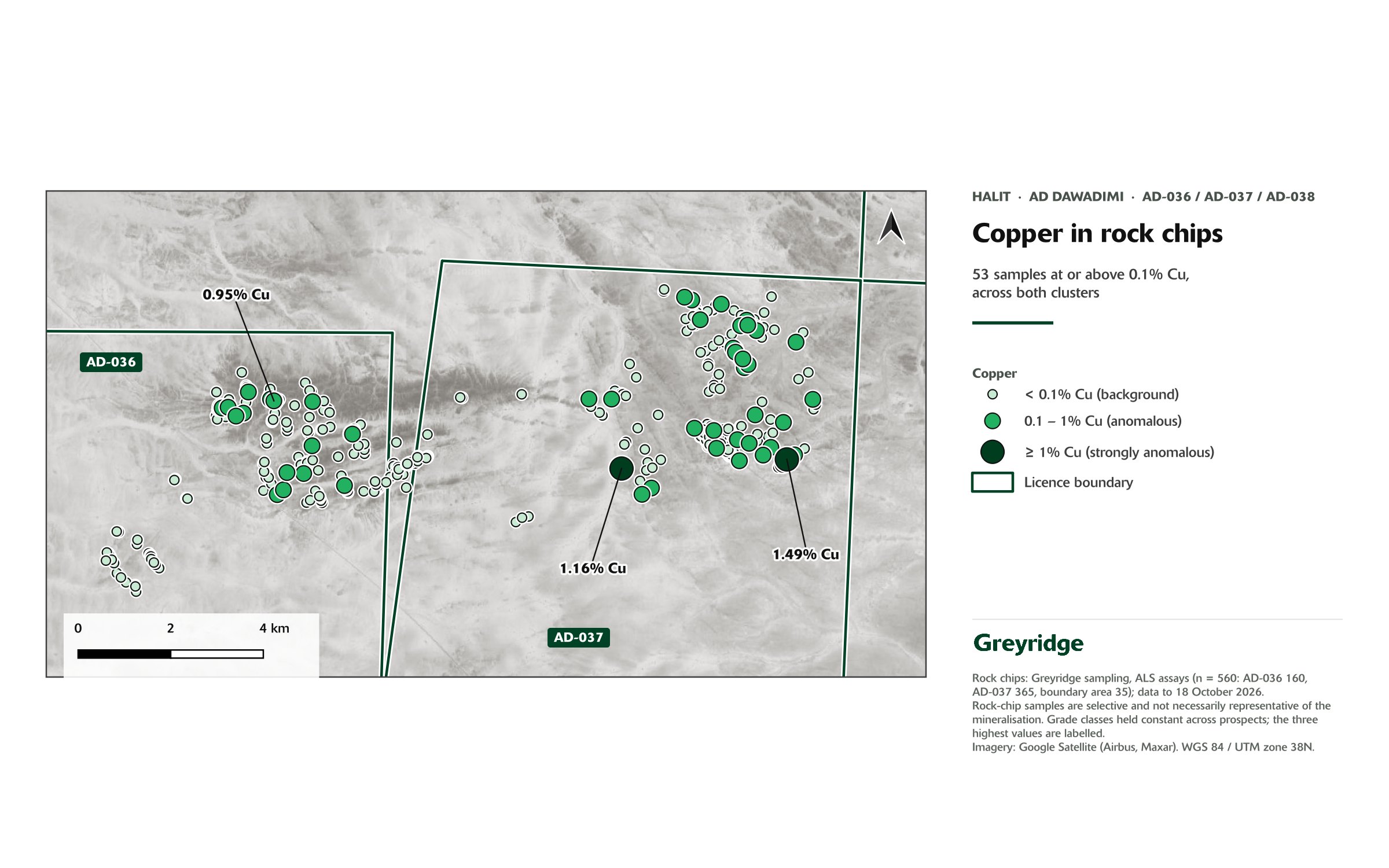
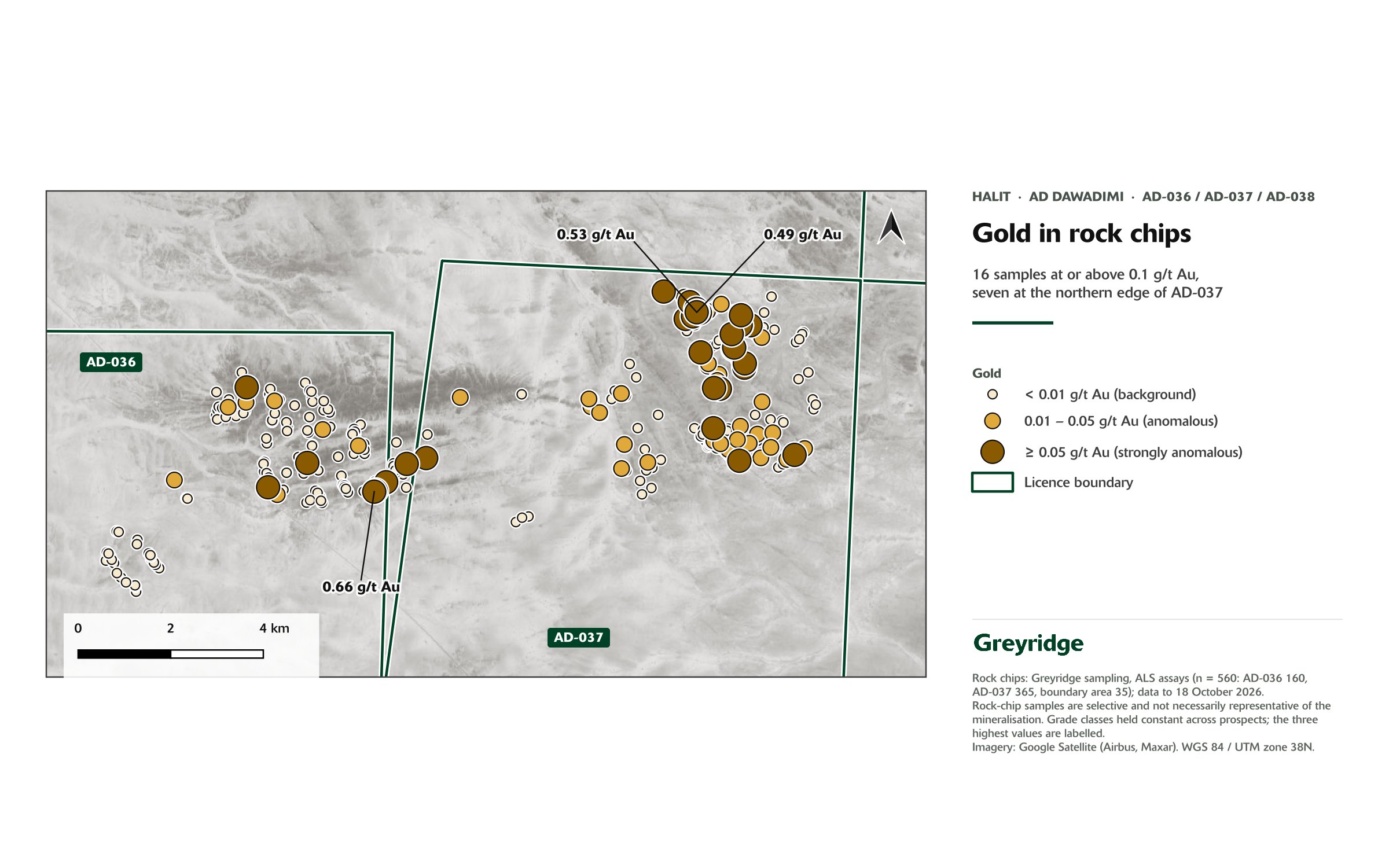
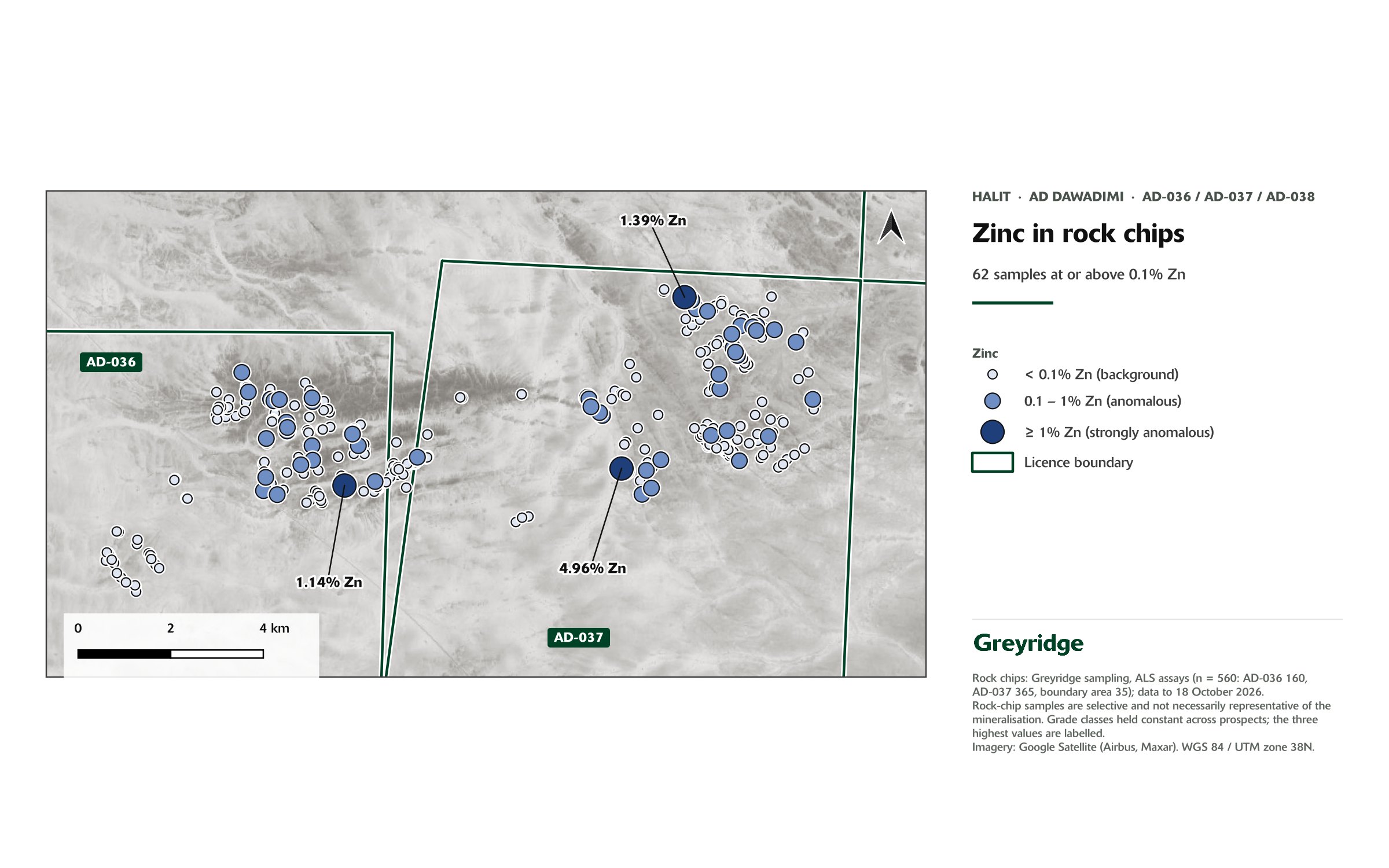
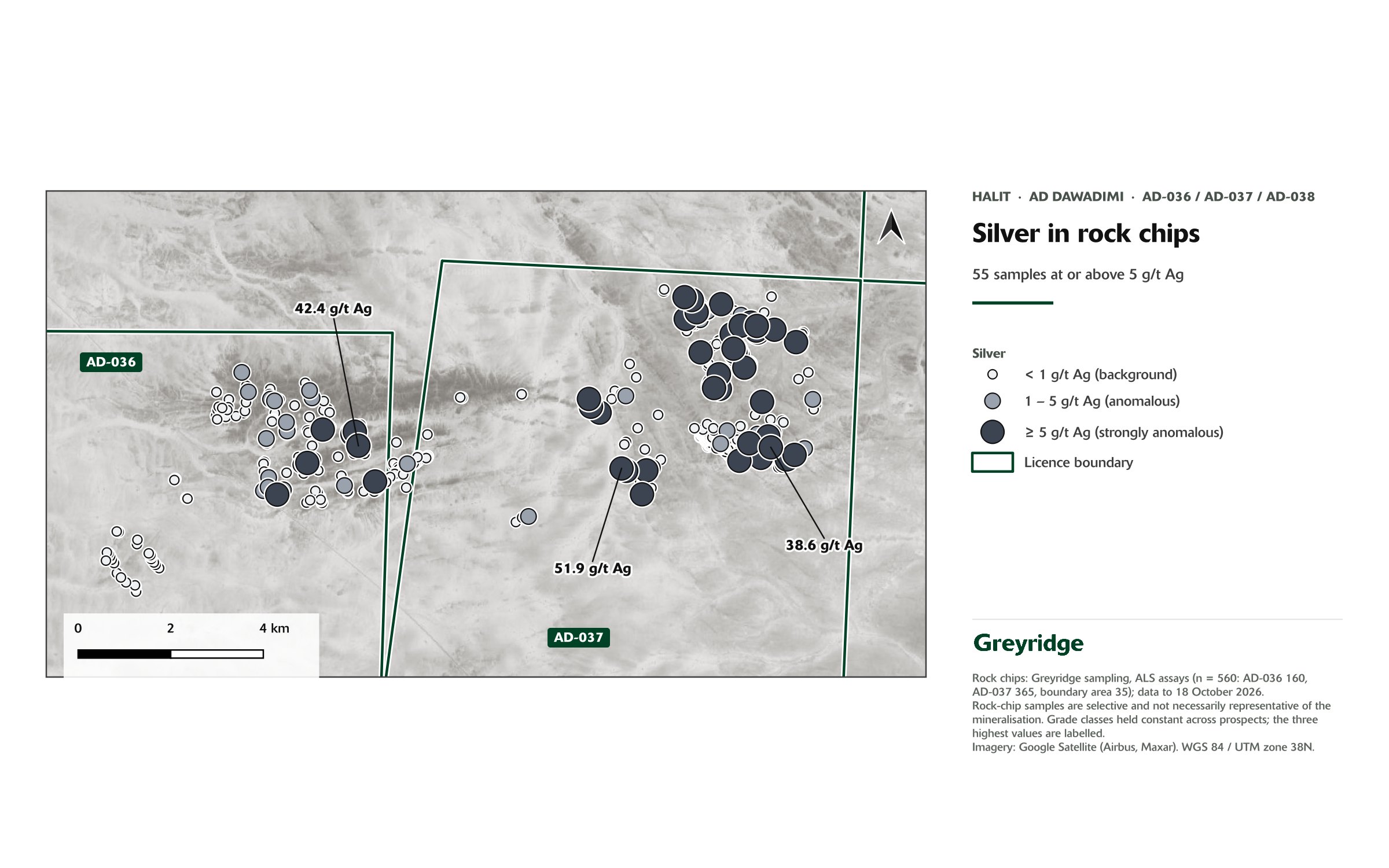


Rock chip samples are selective in nature and are not necessarily representative of the mineralisation hosted on the licences. Grades describe the material collected. Neither cluster has been drilled.
Next steps
Width, grade and depth
- Trench assays from AD-036 and AD-037: the first measures of width and grade.
- Geophysics: magnetics over AD-036, and induced polarisation over the AD-037 eastern domain and the AD-036 copper cluster.
- Coverage: sampling east of the current limit at AD-037, and first-pass work on AD-038.
- Multi-element re-assay, alteration mineralogy and dating of the host intrusions.
- Rock chips: 560 samples (AD-036 160, AD-037 365, area between the licences 35), ALS Au-AA24 and ME-ICP41 with ore-grade re-assay of over-limit copper, lead and zinc; samples collected October 2024 to June 2026. The old pit in northern AD-037 is Ministry occurrence 0820 (Sinaf Uraynibah); historical occurrences are not necessarily indicative of mineralisation elsewhere on the licences. See technical disclosure.
Updated 23 October 2026